
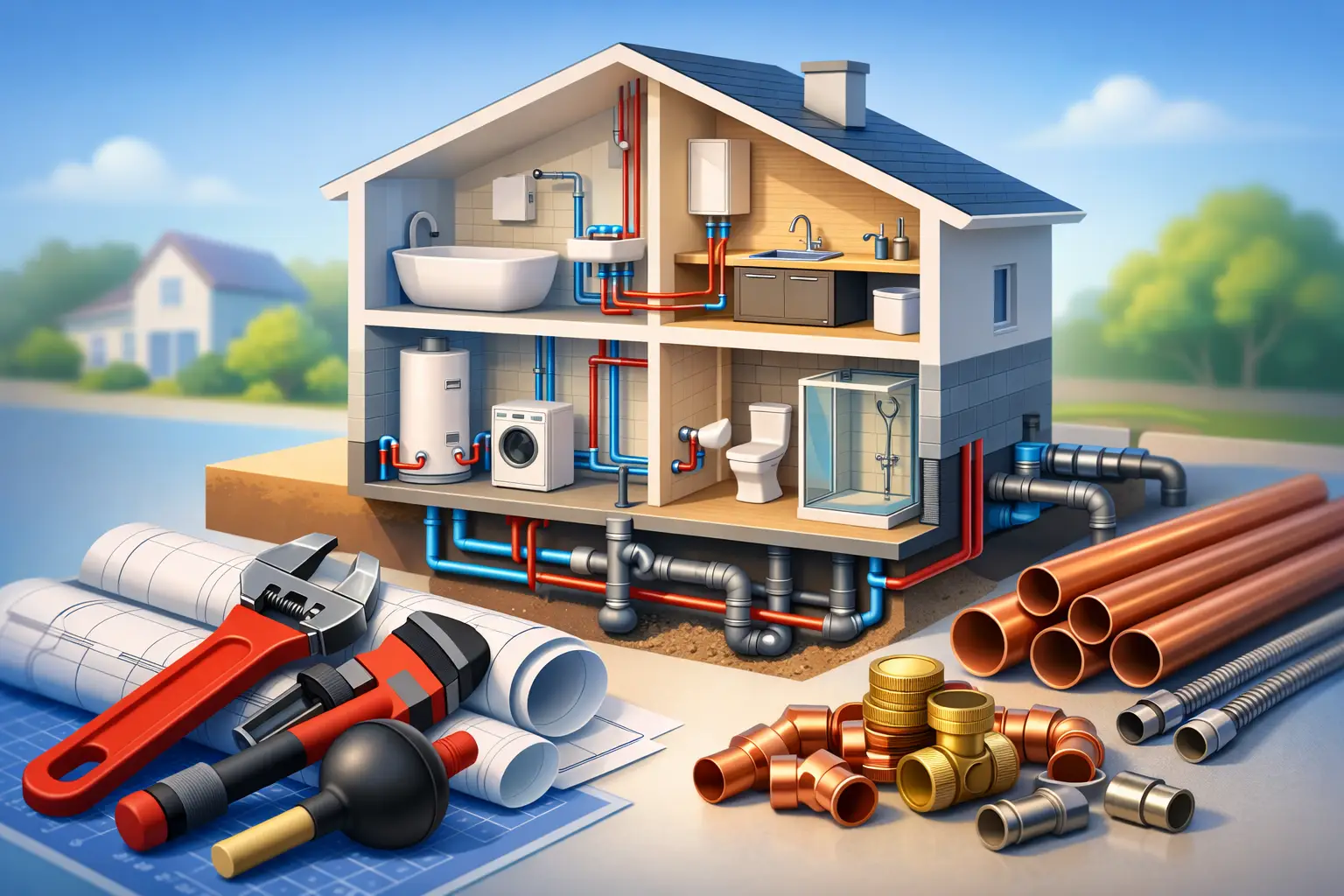
Whole House Plumbing Cost: What to Expect
If you are trying to budget for a major plumbing project, whole house plumbing cost usually comes down to one basic question: are you replacing a few problem areas, or are you rebuilding the system that keeps the entire home running? That difference can move the price from a manageable repair bill to a larger investment, especially in older homes across Middle Tennessee.
For homeowners, the hard part is that there is no single flat rate that fits every property. A one-story home with easy access to lines is a very different job from a two-story house with aging pipes behind finished walls, an outdated water heater setup, and sewer or water line concerns outside the home. The more complete the scope, the more the price reflects labor, materials, access, and the condition of the home itself.
What whole house plumbing cost usually includes
When people ask about whole house plumbing cost, they may be talking about very different projects. In some cases, they mean a full repipe of the hot and cold water lines. In others, they mean rough-in and finish plumbing for a renovation or new construction. Some homeowners are thinking even bigger and including fixtures, drains, sewer connections, and water heater replacement in the total.
That is why estimates can vary so widely. A basic whole-home plumbing project may include replacing supply lines, reconnecting existing fixtures, and testing the system. A more involved project may also include drain line work, new shutoff valves, fixture upgrades, water filtration equipment, or underground repairs. The scope matters more than the phrase.
For an existing home, a full repipe is often the clearest example of a whole-home plumbing cost. That project focuses on replacing old water lines throughout the house, especially when the home has frequent leaks, poor pressure, discolored water, or outdated materials that are reaching the end of their service life.
Typical price ranges for whole house plumbing cost
A smaller or more straightforward whole-home repipe may start around $8,000 to $15,000. A mid-range project for an average-sized house often lands between $15,000 and $25,000. Larger homes, more complex layouts, higher-end material choices, or projects that also include drains, fixtures, or water heater work can push totals to $25,000 to $40,000 or more.
Those numbers are broad on purpose. They are not a quote, and they should not be treated like one. They are simply a realistic way to understand how quickly the budget can change based on the home and the exact work involved.
If the project is new construction, the pricing structure is different. Plumbing for a new home may be priced based on the floor plan, number of bathrooms, kitchen layout, fixture count, slab or crawlspace access, and whether specialty systems are being installed. In those cases, homeowners are not paying for demolition and repair of existing finished spaces, but they are still paying for labor, design complexity, and materials.
What drives the cost up or down
Square footage matters, but it is not the only factor. A compact home with difficult access can cost more than a larger home with exposed lines in a crawlspace or unfinished basement.
Pipe material
Material choice affects both price and long-term performance. PEX is often more budget-friendly and flexible for repiping work, while copper generally costs more in both material and labor. Some homeowners prefer one over the other based on durability, water quality concerns, or the layout of the house. There is no universal right answer. It depends on the home, the budget, and the plumber's recommendation.
Access to plumbing lines
Open access lowers labor time. If pipes are easy to reach through a crawlspace, unfinished area, or accessible wall cavities, the work is usually more efficient. If the home has finished walls, tile, custom cabinetry, or tight ceiling spaces, labor goes up because more time is required to reach, replace, and restore the affected areas.
Age and condition of the home
Older homes often come with hidden issues. A repipe may begin as a supply-line project and then reveal outdated shutoffs, corroded branch connections, poor drain conditions, or code updates that need to be addressed. This is one reason older homes rarely fit neatly into online price averages.
Number of bathrooms and fixtures
A home with two bathrooms, one kitchen, and a laundry area is very different from a property with multiple bathrooms, a soaking tub, a wet bar, and specialty plumbing features. More fixtures mean more connections, more labor, and more testing.
Water heater and filtration upgrades
Homeowners often choose to handle related upgrades while the plumbing system is already being worked on. Replacing an aging water heater, installing a filtration system, or improving shutoff access can make sense during a major plumbing project. It can also increase the total investment in a worthwhile way if those systems are already nearing replacement.
Underground water or sewer issues
If the whole house plumbing cost also includes underground water line or sewer line work, pricing changes significantly. Excavation, line replacement, location of the issue, depth, soil conditions, and restoration all affect the final total. These projects are often separate from a repipe, but they can overlap in older properties with widespread plumbing problems.
Why estimates vary so much from house to house
Two homes on the same street can have very different plumbing costs. One may have had partial updates over the years, while the other still has original piping. One may have a crawlspace that allows quick access, while the other may require opening finished walls in several rooms. Even local water quality and years of wear can affect the condition of the system.
That is why a real on-site evaluation matters. A dependable estimate is built around what is actually in the home, not just square footage or the year it was built. Homeowners deserve a clear explanation of what is being replaced, what can stay, and whether the estimate includes patching, fixtures, or related upgrades.
When a whole-house plumbing project makes sense
Not every plumbing problem calls for whole-home replacement. If the issue is isolated and the rest of the system is in good shape, a focused repair is often the smarter choice. A trustworthy plumber should tell you that.
A full-house plumbing project starts making more sense when leaks are becoming frequent, repairs are stacking up, water pressure is inconsistent, or the home still has aging materials with a known history of failure. It can also make sense before a major remodel, especially if walls and floors will already be open.
For some homeowners, the decision is partly financial. Paying for repeated repairs on a deteriorating system can eventually cost more than replacing the plumbing in a planned, organized way. There is still an upfront investment, but it may reduce disruption and uncertainty over time.
How to plan for whole house plumbing cost
Start with the scope, not the number. Ask whether you need a full repipe, drain work, fixture replacement, water heater installation, or underground line repair. Once the scope is clear, the pricing becomes more meaningful.
It also helps to ask what is included in the estimate. Some proposals cover only the plumbing work itself. Others may include demolition, basic wall access, reconnecting fixtures, testing, permits, and cleanup. If patching and finish repairs are not included, homeowners should know that upfront so there are no surprises.
Timing can matter too. If you are already planning a bathroom update, kitchen renovation, or water heater replacement, combining projects may be more efficient than handling them separately. That does not always lower the total cost, but it can reduce duplicate labor and minimize repeat disruption to the home.
For homeowners in this area, local experience matters. Soil conditions, home styles, crawlspace access, and the age of housing stock across Middle Tennessee all affect how a plumbing project is approached. A residential plumbing company that works in these communities regularly will be better positioned to give a practical recommendation based on the actual home, not a generic online formula.
Cornerstones Plumbing, LLC works with homeowners who want clear answers, dependable workmanship, and a realistic plan for their home plumbing needs. That is especially important on larger projects where cost, access, and long-term reliability all have to be weighed carefully.
If you are pricing a major plumbing job, the goal is not to find the lowest number on the internet. It is to understand what your home actually needs, what the estimate covers, and whether the work will solve the problem for the long run.


Comments